
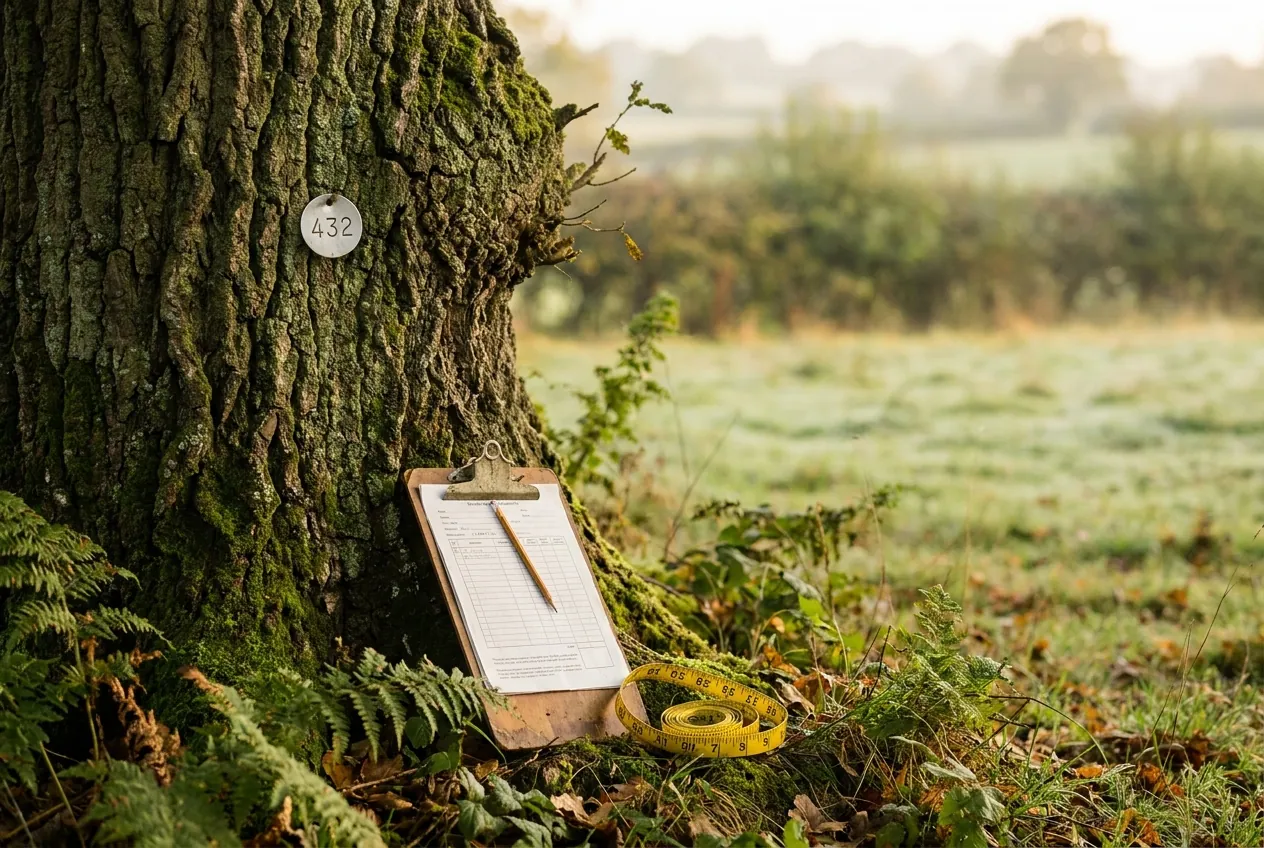
Arboricultural Surveys
BS5837 Tree Surveys for Planning
What they are, when you need one and exactly what you get — clear tree surveys to BS5837:2012 that keep your planning application moving.
What is a BS5837 tree survey? It’s an arboricultural survey carried out to British Standard BS5837:2012. A qualified arboriculturist records the trees on and around your site, gives each a retention category (A, B, C or U), and produces the tree constraints information a planning authority needs to assess the proposal.
Almond Arb & Ecology carries out BS5837 tree surveys across Leicestershire for homeowners, architects, developers and local authorities. You get a clear, professionally-presented report your planning officer will accept — and honest advice on how the trees affect what you can build.
When does planning need a tree survey?
A local planning authority will normally ask for a BS5837 tree survey where there are trees on or next to a site that could be affected by development. Common triggers include:
- New dwellings, extensions or outbuildings near existing trees
- Sites containing trees protected by a Tree Preservation Order (TPO) or in a Conservation Area
- Development close to significant or mature trees (including neighbouring trees)
- Any proposal where trees might be removed, pruned or affected by construction
Submitting the survey with your application usually helps it get validated first time and avoids a request for further information later.
What’s in the report
A full BS5837 output has several parts, produced as your project needs them:
Tree schedule
Every relevant tree recorded with species, height, stem diameter, crown spread, age class, condition and an estimated remaining life — and a retention category: A (high quality), B (moderate), C (low) or U (unsuitable for retention).
Tree Constraints Plan (TCP)
A drawing showing each tree’s Root Protection Area (RPA) and canopy, so the design can be planned around what must be protected.
Arboricultural Impact Assessment (AIA)
Where development is proposed, the AIA assesses how the scheme affects the trees and which can be retained. See our arboricultural consultancy for standalone AIA advice.
Arboricultural Method Statement & Tree Protection Plan
The practical document set — protective fencing, ground protection and working methods — that a planning condition will often require before works start on site.
How much does a tree survey cost?
| Site | Typical cost |
|---|---|
| Small domestic site (a few trees) | from £300–£500 |
| Larger garden / multiple trees + constraints plan | from £500–£900 |
| Development site with AIA + Method Statement | from £900+ |
The main cost drivers are the number of trees, the size and access of the site, and whether you also need the AIA and Method Statement.
Timescales & how to start
Unlike bat surveys, a tree survey can be done at any time of year. Once instructed we can usually complete the site visit within a week or two and turn the report around promptly to suit your planning deadline. To get started, send us your site address and, if you have them, a location plan and any drawings — we’ll come back with a fixed quote within one working day.
Why use a qualified arboriculturist?
A BS5837 report is only useful if the planning authority accepts it. Almond Arb & Ecology holds a National Diploma in Forestry & Arboriculture and produces surveys to the current standard, with the categorisation and drawings officers expect — and the practical experience to advise what your scheme can realistically retain.
Get a tree survey quote
Tree survey FAQs
Do I need a tree survey if the trees are on my neighbour’s land?
Possibly — if a neighbouring tree’s canopy or roots reach your site, its Root Protection Area can still constrain your design, so it may need to be included.
What are the tree categories A, B, C and U?
They grade a tree’s quality and suitability for retention: A = high quality, B = moderate, C = low, U = unsuitable for retention (e.g. dead or dangerous). The categories help the planner weigh trees against the development.
How long does a tree survey take?
Typically a site visit within a week or two of instruction, then a prompt report turnaround. We’ll confirm timings against your planning deadline when we quote.
Do you cover my area?
Yes — Leicestershire and surrounding counties. Send your postcode and we’ll confirm.
Need a tree survey?
BS5837:2012, fixed quotes, reports planning will accept. Reply within one working day.
Related services
The essentials
- Standard: BS5837:2012
- Any time of year
- Tree schedule + constraints plan
- AIA + Method Statement as needed